
1FundingWhich agencies are eligible to use JDN funding for cloud computing service subscriptions?
Government Hybrid Cloud (GHC) funding is currently available only to Federal Ministries and Departments.
2FundingDoes JDN cover the cost of using cloud services?
Agencies may apply to JDN for cloud computing funding under the Government Hybrid Cloud (GHC) project. Funding may only be used for the following service scope:
- Infrastructure as a Service (IaaS);
- Platform as a Service (PaaS);
- Software as a Service (SaaS);
- Cloud professional services offered by the CSP and MSP panel; and
- Cloud managed services offered by MSPs.
Professional and managed services that are not directly related to the cloud computing services offered by the CSP and MSP panel are outside the scope funded by JDN. JDN GHC funding covers only the five (5) service types above provided by the four (4) CSPs and four (4) MSPs.
Other services, such as system development, maintenance and support, and similar services are not funded by JDN.
Note: Only the services listed above are funded by JDN under GHC.
3FundingWhich services fall outside JDN GHC project funding and must be funded by agencies?
System development requiring the appointment of a System Integrator (SI), system maintenance, and system operation/managed services must be provided using the agency's own funding.
4ApplicationsWhat is the procedure for applying for cloud computing service subscriptions?
Under SPA No. 7 of 2024, technical approval for cloud computing applications valued below RM10 million is at Agency/Ministry JPICT level.
However, after obtaining JPICT approval, agencies must apply to JDN at mygovcloud@jdn.gov.my for:
- Use of JDN funding;
- Direct negotiation where only one CSP/MSP panel member can supply the required service (sole provider under PK2.6); and
- Cloud computing or CFA exemption applications.
There are four (4) cloud procurement procedures:
A. Projects Below RM10 Million Using JDN Funding
- Identify core business requirements based on stakeholder requirements and estimate the funding needed;
- Assess information security risks to identify technologies that protect official data at all processing stages;
- Classify data in accordance with General Circular Letter No. 2 of 2021: Guidelines for Information Security Management through Cloud Computing in the Public Service;
- Obtain the Chief Government Security Office (CGSO) views/comments on the proposed security architecture to ensure compliance with SPA No. 2/2021 and Chief Government Security Officer Circular Letter No. 4 of 2023 concerning Government building construction/renovation and ICT system security risk assessment;
- Conduct market research and a proof of concept (POC), where necessary:
- For Official Information: conduct market research with all four MSPs; or
- For Official Secrets (Restricted and Confidential): conduct market research with MSPs offering cloud services with domestic data residency.
- Obtain JDN advice on cloud computing implementation, where required;
- Obtain Ministry/Agency JPICT approval;
- Obtain JDN JPPCSA approval; and
- Conduct procurement in accordance with PK2.6.
B. Projects Below RM10 Million Using Funding Other Than JDN Funding
- Identify core business requirements based on stakeholder requirements and estimate the funding needed;
- Assess information security risks to identify technologies that protect official data at all processing stages;
- Classify data in accordance with General Circular Letter No. 2 of 2021: Guidelines for Information Security Management through Cloud Computing in the Public Service;
- Obtain the Chief Government Security Office (CGSO) views/comments on the proposed security architecture to ensure compliance with SPA No. 2/2021 and Chief Government Security Officer Circular Letter No. 4 of 2023 concerning Government building construction/renovation and ICT system security risk assessment;
- Conduct market research and a proof of concept (POC), where necessary:
- For Official Information: conduct market research with all four MSPs; or
- For Official Secrets (Restricted and Confidential): conduct market research with MSPs offering cloud services with domestic data residency.
- Obtain JDN advice on cloud computing implementation, where required;
- Obtain Ministry/Agency JPICT approval;
- Conduct procurement in accordance with PK2.6.
C. Projects Valued at RM10 Million and Above
Follow the JTISA technical approval application procedure:
- Identify core business requirements based on stakeholder requirements and estimate the funding needed;
- Assess information security risks to identify technologies that protect official data at all processing stages;
- Classify data in accordance with General Circular Letter No. 2 of 2021: Guidelines for Information Security Management through Cloud Computing in the Public Service;
- Obtain the Chief Government Security Office (CGSO) views/comments on the proposed security architecture to ensure compliance with SPA No. 2/2021 and Chief Government Security Officer Circular Letter No. 4 of 2023 concerning Government building construction/renovation and ICT system security risk assessment;
- Conduct market research and a proof of concept (POC), where necessary:
- For Official Information: conduct market research with all four MSPs; or
- For Official Secrets (Restricted and Confidential): conduct market research with MSPs offering cloud services with domestic data residency.
- Obtain JDN advice on cloud computing implementation, where required;
- Obtain Ministry/Agency JPICT approval;
- Obtain JTISA approval; and
- Conduct procurement in accordance with PK2.6.
D. Projects Below RM10 Million Using Non-JDN Funding and an MSP Sole Provider
- Conduct market research through the sole provider;
- Obtain Ministry/Agency JPICT approval;
- Complete and submit the cloud computing service application template to mygovcloud@jdn.gov.my. The template is available on the MyGovCloud@CFA portal;
- JDN confirms that the product is offered by only one CSP (sole provider) and may be procured through direct negotiation; and
- Conduct procurement in accordance with PK2.6.
Note: Applications for JPPCSA approval must be submitted to JDN at mygovcloud@jdn.gov.my.
5ApplicationsWhat criteria determine whether a cloud subscription project requires JDN approval?
Under SPA 7/2024: Guidelines for Technical Approval Applications and Monitoring of Public Sector Information and Communication Technology (ICT) Projects, technical approval is based on the following project value thresholds:
| PROJECT | APPROVAL LEVEL | |||
|---|---|---|---|---|
| Project Scope | Project Value (RM) | Secretary-General / Head of Department | Ministry JPICT | JTISA |
| System Development | < 200k | / | ||
| ≥ 200K < 5J | / | |||
| ≥ 5J | / | / | ||
| Hardware / Software / Networks / Network Equipment / Services | < 200k | / | ||
| ≥ 200K < 10J | / | |||
| ≥ 10J | / | / | ||
| A combination of system development and/or hardware, software, networks and ICT service equipment. Combinations involving system development costs above RM5 million must be referred to JTISA. | < 200k | / | ||
| ≥ 200K < 10J | / | |||
| ≥ 10J | / | / | ||
| PROJECT | APPROVAL LEVEL | ||||
|---|---|---|---|---|---|
| Project Scope | Project Value (RM) | Head of Agency | Agency JPICT | Ministry JPICT | JTISA |
| System Development | < 50k | / | |||
| < 200k | / | ||||
| ≥ 200K < 5J | / | / | |||
| ≥ 5J | / | / | / | ||
| Hardware / Software / Networks / Network Equipment / Services | < 50k | / | |||
| < 200k | / | ||||
| ≥ 200K < 10J | / | / | |||
| ≥ 10J | / | / | / | ||
| A combination of system development and/or hardware, software, networks and ICT service equipment. Combinations involving system development costs above RM5 million must be referred to JTISA | < 50k | / | |||
| < 200k | / | ||||
| ≥ 200K < 10J | / | / | |||
| ≥ 10J | / | / | / | ||
6ApplicationsDo all cloud subscription projects undertaken by Federal Ministries and Departments require JDN approval?
- All projects costing above RM10 million require JTISA approval.
- Projects costing below RM10 million require JPPCSA approval only for the following matters:
- Applications to use Government Hybrid Cloud (GHC) funding;
- Applications to confirm procurement through direct negotiation;
- Applications for cloud computing or Cloud Framework Agreement (CFA) exemptions; and
- Applications for approval to procure Microsoft licences.
Note: Applications for JPPCSA approval must be sent to mygovcloud@jdn.gov.my.
7ApplicationsWhat is the application procedure for Google Workspace for Education?
- Obtain JPICT approval at Ministry/Agency level;
- Complete and submit the cloud computing service application template to urussetiajtisa@jdn.gov.my and mygovcloud@jdn.gov.my. The application template is available on the JDN portal;
- JDN confirms that Google Workspace for Education is offered by only one MSP (sole provider) and may be procured through direct negotiation; and
- Conduct procurement in accordance with PK2.6.
Note: Google Cloud Malaysia Sdn. Bhd. appointed Awantec System Sdn. Bhd. as the MSP for Google Workspace products.
8ApplicationsWhat are the application and procurement procedures after the CFA expires?
Applications and procurement for cloud computing subscriptions during the CFA extension period may proceed as usual under the current procedures in force until further notification regarding CFA 2.0.
9ProcurementWhich circulars provide guidance on cloud computing procurement?
- National Digital Department Director-General Directive Letter No. 2 of 2026: Public Sector Whole-of-Government (WoG) Guidelines;
- General Circular Letter No. 7 of 2024: Guidelines for Technical Approval Applications and Monitoring of Public Sector ICT Projects;
- Chief Government Security Officer Circular Letter No. 4 of 2023: Security Instructions for Government Building Construction and Renovation and ICT System Security Risk Assessment;
- PK 2.6: Public Sector Cloud Computing Services Procurement;
- General Circular Letter No. 2 of 2021, Version 2.0: Guidelines for Information Security Management through Cloud Computing in the Public Service; and
- PKPA No. 1 of 2021: Public Sector Cloud Computing Services Policy.
10ProcurementWhich field codes are appropriate for cloud computing procurement?
| 210103 | Software all computer software, operating system, database, off-theshelf packages including maintenance. |
| 210104 | Software / system development including maintenance-data entry / data processing. |
| 210105 | Telecommunication / networking supply product, infrastructure, services including maintenance LAN / WAN / Internet / wireless / satellite. |
| 210106 | Data management – provide service including maintenance (database / web hosting, disaster, planning / recovery, information storage / retrieval). |
| 210107 | ICT security and firewall, Encryption, PKI, Antivirus. |
11ProcurementHow should Microsoft software licences be procured?
| Contract Status | Procurement Method |
|---|---|
| Contracts Still in Force |
|
| Expired Contracts | Licence renewal must follow PK2.6 for a three-year term. |
| New Contracts | New procurement must follow PK2.6 for a three-year term. |
Note: The Master Licensing Agreement (MLA) central contract expired on 1 February 2021.
12ProcurementWhat is the procurement procedure for Google Workspace for Education?
- Obtain JPICT approval at Ministry/Agency level;
- Complete and submit the cloud computing service application template to urussetiajtisa@jdn.gov.my and mygovcloud@jdn.gov.my. The application template is available on the JDN portal;
- JDN confirms that Google Workspace for Education is offered by only one MSP (sole provider) and may be procured through direct negotiation; and
- Conduct procurement in accordance with PK2.6.
Note: Google Cloud Malaysia Sdn. Bhd. appointed Awantec System Sdn. Bhd. as the MSP for Google Workspace products.
13ProcurementDoes direct negotiation apply to cloud computing service procurement?
Under PK2.6: Public Sector Cloud Computing Services Procurement, paragraph 5.3.1(c):
If the required cloud technology is specific and can be supplied by only one CSP (sole provider) within the CSP panel, MAMPU (now known as JDN) must confirm this and determine whether direct negotiation is appropriate. Agencies must negotiate prices in accordance with the procedures in force before finalisation by the Procurement Authority (PBM).
14ExemptionsWhat is the application procedure for cloud computing or CFA exemptions?
Agencies must submit an exemption application to JDN by email/official letter, including:
- Cloud Computing Exemption
- Information about the proposed project;
- Justification for why cloud computing is unsuitable for the project; and
- Supporting documents, such as legislation, data classification or system architecture, consistent with PKPA 1/2021 paragraph 12, that substantiate the justification.
- CFA Exemption
- Details of the services to be subscribed to; and
- Supporting documents, such as emails, from all CSP panel members confirming that they do not provide the services.
15ExemptionsMust all Public Sector Agencies obtain JDN approval or confirmation for cloud computing implementation or exemption?
Yes.
Cloud Computing Exemption — PKPA 1/2021, paragraph 12: Exemption from cloud computing services is permitted where there are legal, security or system architecture constraints, or high-performance processing requirements.
16ExemptionsWhat if a requested cloud product or service is not offered by the CSP panel?
PK2.6, paragraph 3.2:
Agencies seeking cloud services other than those listed on https://mygovcloudcfa.gov.my, services unavailable from the CSP/MSP panel, or services involving security/legal considerations must use the existing procurement procedures in force and obtain JDN approval for exemption from CFA.
Scenario 1
An exemption may be considered where the product/service is widely used in the public sector, such as Adobe, Kahoot or AutoCAD.
Scenario 2
Where the product/service is not widely used in the public sector and the applicant agency has not used it:
- The agency must conduct market research among the four (4) MSP/CSP panel members to identify equivalent products/services; and
- If the market research finds no equivalent product, an exemption may be considered.
17SecurityHow are Malaysian Government data governance and security controls managed under CFA?
- CSPs that have entered into CFA with the Government are bound to provide secure and reliable services in accordance with the agreed service scope and prices.
- MSPs/CSPs must not disclose any data or information to another party without the Malaysian Government's prior written consent. They must also ensure that the agreement is governed by Malaysian law.
- If the CSP cloud services, including data stored by CSPs and MSPs, are proven insecure, the Government may discontinue CFA and terminate any Implementation Agreement at any time. The Implementation Agreement refers to the negotiated terms and conditions governing the CSP cloud services provided to the relevant public sector agency.
18SecurityHow does CFA mitigate the risk of data access by foreign authorities, such as under the U.S. CLOUD Act?
- The CLOUD Act permits technology providers under U.S. jurisdiction to disclose requested data even when stored outside the U.S. However, enforcement in foreign countries must respect sovereignty and territorial principles. U.S. CLOUD Act requests are also subject to the Malaysia–U.S. Mutual Legal Assistance Treaty. Requests must not compromise national sovereignty or security and must satisfy dual criminality and threshold requirements to determine whether an offence is a serious offence in Malaysia.
- In implementing CFA in Malaysia, the Government has taken this into account. Government data hosted with domestic CSPs is protected under the Mutual Assistance in Criminal Matters Act 2002 [Act 621], under which foreign authority requests for criminal investigations must follow diplomatic channels.
- Because the data centres are within Malaysia's physical borders, physical access rights, enforcement action and seizure orders are fully subject to Malaysian law.
- For risk mitigation, agencies must comply with all applicable Government acts, regulations, instructions, policies and circulars concerning information protection and cloud computing.
19SecurityWhat safeguards are required under CFA to protect classified Malaysian Government information?
- Contractual and Legal Aspects
JDN will provide a cloud subscription contract template for implementing agencies to refine with their respective Legal Officers (PUU). Security-related clauses include:
- Clause 8: Compliance with Government Policies and Cloud Technical Requirements;
- Clause 9: Company Obligations;
- Clause 10: Indemnity and Liability;
- Clause 11: Confidentiality;
- Clause 16: Termination in the National Interest, National Security, Government Policy or Public Policy;
- Clause 18: Security and Security Procedures;
- Clause 20: Intellectual Property Rights; and
- Other relevant provisions as required.
- Governance Aspects
Under the Security Instructions (Revision and Amendment 2017), data owners are fully responsible for providing appropriate protection for Government information.
- Technical Controls
Data owners must implement controls under General Circular Letter No. 2 of 2021: Guidelines for Information Security Management through Cloud Computing in the Public Service, including:
- Data Encryption: Use encryption algorithms certified as secure by the Government (AKSA MySEAL); and
- Data Backup Management: Perform backups and regular data restoration tests.
20SecurityWhat official risk assessments, guidelines and policies are available as references for public sector cloud computing?
- Government agencies responsible for information protection and cybersecurity have developed information security instructions, policies and guidelines.
- Public sector agencies are responsible for classifying information, assessing data security risks and implementing appropriate safeguards in compliance with current Government instructions and circulars, including:
- Security Instructions (Revision and Amendment 2017);
- Public Administration Development Circular No. 1 of 2021: Public Sector Cloud Computing Services Policy;
- General Circular Letter No. 2 of 2021, Version 2.0: Guidelines for Information Security Management through Cloud Computing in the Public Service;
- General Circular Letter No. 4 of 2022: Guidelines for Electronic Media Sanitisation in the Public Service;
- Chief Government Security Officer Circular Letter No. 4 of 2023: Security Instructions for Government Building Construction and Renovation and ICT System Security Risk Assessment;
- General Circular Letter No. 3 of 2024: Public Sector Information Security Risk Management Guidelines;
- General Circular Letter No. 4 of 2024: Public Sector Network and ICT System Security Level Assessment Guidelines; and
- General Circular Letter No. 1 of 2025: Business Continuity Management (BCM) Guidelines in the Public Service.
21SecurityWhat additional security clause is recommended for cloud service subscription contracts?
For any CSP under CFA supplying cloud computing services to the Government by using or integrating services from a foreign CSP or a third party appointed by that CSP outside CFA, where those services are subject to the jurisdiction and laws of the CSP's country of origin, including but not limited to the U.S. CLOUD Act or similar legislation, the CSP and MSP under this CFA contract are fully responsible for any actions of that foreign CSP or third party.
Accordingly, the CSP or MSP must obtain prior written consent and authorisation from the Malaysian Government through JDN before taking any action contrary to this contract's obligations, including granting access to, disclosing or revealing Government data or data held under the cloud computing services to any civilian party or foreign authority.
22OthersWhich agencies are eligible to use CFA?
PKPA No. 1/2021
This circular applies to all Federal Public Service agencies. Subject to acceptance by the respective authorities, its provisions extend to:
- State Public Services;
- Statutory Bodies; and
- Local Authorities (PBT).
SPA No. 7/2024
This General Circular Letter applies to all Public Sector agencies for ICT projects financed by Federal funding or implemented through Private Finance Initiative (PFI)/Public-Private Partnership (PPP) arrangements.
Agencies should refer to PKPA No. 1/2021 and SPA No. 7/2024.
23OthersWhat is the cloud computing subscription period under CFA?
The cloud computing service subscription period under CFA for each project is between three (3) and five (5) years.
24OthersMust agencies classify data before applying for Government Hybrid Cloud (GHC) services?
Yes. Data classification is important in determining the appropriate cloud environment: public cloud (GHC), private cloud (PDSA) or the agency's own data centre.
25OthersWhat additional cloud security measures should agencies implement, particularly for classified data?
Agencies must assess information security risks to identify technologies that protect official secrets at every cloud processing stage: data at rest, data in transit and data in use.
26OthersWho provides Public Sector Cloud Computing Services?
Public Sector Cloud Computing Services combine JDN's role as the Government cloud service provider with four (4) CSP panel members:
- Amazon Web Services (AWS) Sdn. Bhd.;
- Google Cloud Malaysia Sdn. Bhd.;
- Microsoft (Malaysia) Sdn. Bhd.; and
- Telekom Malaysia Berhad.
The MSPs are local companies appointed by the respective CSPs:
- Radmik Solutions Sdn. Bhd.;
- Awantec System Sdn. Bhd.;
- Enfrasys Solutions Sdn. Bhd.; and
- Cloud Connect Sdn. Bhd.
27OthersWhat is the validity period of the current Cloud Framework Agreement (CFA)?
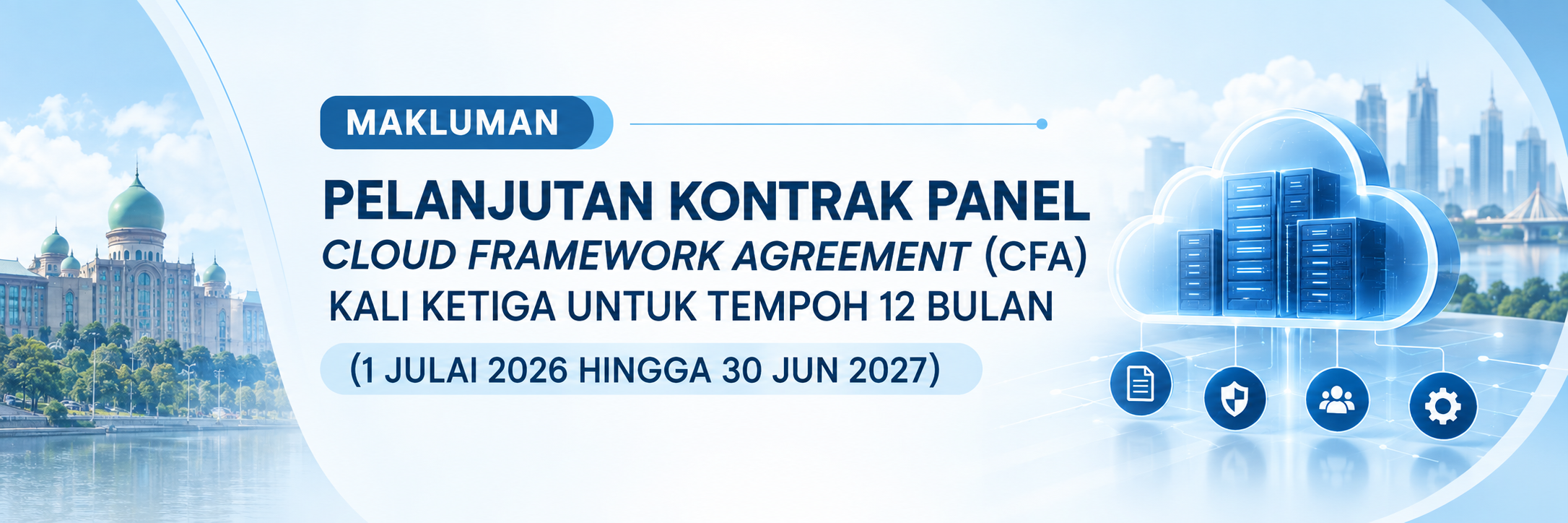
| CSP PANEL | CFA CONTRACT EXPIRY | THIRD CFA CONTRACT EXTENSION |
|---|---|---|
| AWS / Radmik | 31 December 2024 | 1 July 2026- 30 June 2027 |
| Google / Awantec | 31 December 2024 | 1 July 2026 - 30 June 2027 |
| Microsoft / Enfrasys | 28 February 2025 | 1 July 2026 - 30 June 2027 |
| TM / Cloud Connec | 31 December 2024 | 1 July 2026 - 30 June 2027 |
28OthersWill the Government implement CFA 2.0 to continue public sector cloud computing?
JDN completed the MyGovCloud@CFA Impact and Direction Study in September 2024, and it was endorsed by the Ministry of Digital in October 2024.
The proposed implementation of MyGovCloud@CFA 2.0 remains under consideration by the Ministry of Finance.